
Blog Topics
By late October in South Burlington and Williston, sugar maples and ash trees have dropped their leaves, leaving their branch structure in plain view. Defects like two trunks growing from the same point at a tight angle, or a strip of bark trapped where two limbs meet, become easy to spot. That’s usually when homeowners start asking, “What does an arborist look for?”
Such defects are more than cosmetic. A V-shaped union held together by trapped bark is dependent on pressure, and the added weight of ice or wind can be enough to pull it apart. A fall assessment is how an arborist catches that kind of risk on a property before it’s tested by winter conditions.
Key Takeaways
- A fall assessment looks beyond the canopy, because dieback alone can’t show what’s happening at the trunk or roots.
- Co-dominant stems form a tight, V-shaped union instead of a strong, U-shaped one, and included bark inside that union relies on pressure rather than solid wood to hold the stems together.
- Vermont forest monitoring treats an average of about 10% crown dieback as normal and averages above 15% as cause for concern, though those figures describe forest-wide averages, not a limit for any single tree.
- A structural defect doesn’t automatically mean removal: corrective pruning in young trees, or cabling and bracing with regular monitoring, can often keep a mature tree standing.
- October is a good time to schedule a fall assessment in Vermont, since leaf-drop reveals structure while the ground is still workable before winter.
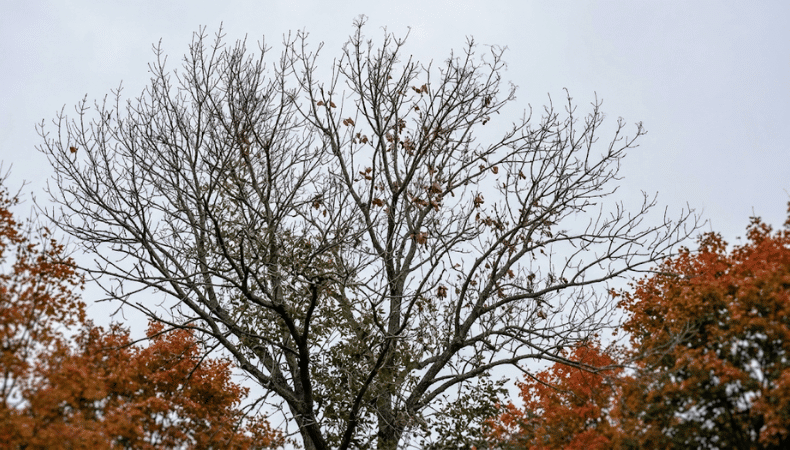
Dieback in the upper and outer crown is the sign homeowners notice first, but it is only part of the picture.
What Does an Arborist Look For During a Walk-Through?
An arborist assessing a Vermont property in fall examines the canopy, trunk and bark, root zone, and site conditions. Each zone shows different signs and, together, creates a complete picture of the tree’s structural health.
The Canopy
In the canopy, an arborist looks for dead branch tips that never leafed out and dieback moving inward from the outer crown, often starting near the top of the tree. Homeowners tend to notice these signs first, but they don’t show what’s happening at the trunk or roots, so the walk-through continues down the tree.
The Trunk and Bark
At the trunk, an arborist checks how branches attach to the main stem and whether the bark and taper look normal for the tree’s age and species. On properties throughout Vermont, two defects show up frequently:
- Co-Dominant Stems : Two or more stems of similar diameter growing from the same point, with no single leader taking over, forming a tight, V-shaped angle rather than a wide, U-shaped union
- Included Bark : Bark trapped inside that V-union instead of the stems fusing into solid wood, so the joint is held together by pressure rather than a true wood-to-wood connection
The tighter the V, the more likely bark is trapped inside the union, and the larger the stems, the more stress that union carries. . Knowing how to identify hazardous trees starts with understanding how these defects show up as visible warning signs.
The Root Zone and Site Conditions
At the base of the tree, an arborist checks where the trunk meets the ground and what the surrounding soil is doing. Homeowners see this zone least, since it’s underground or buried under mulch, so an arborist examines:
- Root Flare Visibility : Whether the point where the trunk widens into the roots is visible at grade
- Drainage Patterns : Whether water pools near the base after rain
- Soil Conditions : Whether compaction from equipment or new construction is stressing the roots
Although it’s the hardest zone to see, an arborist never skips it because a buried root flare, standing water, or compacted soil can stress a tree long before symptoms show in the canopy.
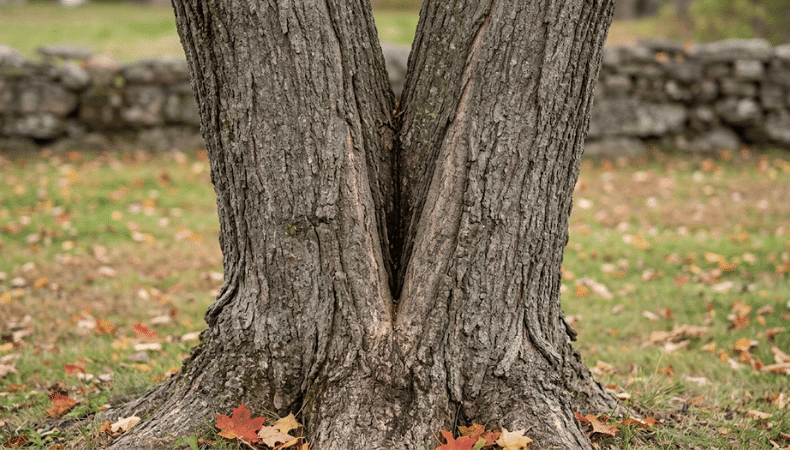
A tight V-shaped union is held together by pressure rather than solid wood, which is why an arborist checks it closely.
Does a Structural Problem Mean a Tree Has to Come Down?
No. Finding an included bark union or a co-dominant stem during a walk-through doesn’t automatically mean tree removal. Instead, it means the arborist can recommend the right level of intervention, usually in this order:
- Written Report : Documents what was found and where, useful for an insurance claim, a permit application, or a dispute with a neighbor over a shared tree
- Corrective Pruning : The usual fix for co-dominant stems or included bark in young trees, removing or reducing one competing stem while the tree is still small enough to handle it
- Cabling or Bracing : For mature trees where pruning alone won’t correct the structure, using cabling and bracing, with cables limiting movement higher in the crown and braces supporting split unions lower on the trunk, though neither removes the risk entirely
- Removal : The last resort, used only when a defect can’t be corrected or supported, and it’s putting a target (a house, a driveway, a power line) at real risk
Limbwalker’s team has four ISA Certified Arborists, two with TRAQ qualifications, to make the call accurately and manage risk efficiently.
When Should You Schedule a Tree Assessment Before Winter?
In Vermont, a great time for a fall assessment is October. The ground’s still unfrozen and workable, so you can schedule and finish any corrective pruning, cabling, or bracing an assessment recommends before winter storms test your tree’s structure.
If you’re unsure whether you need to schedule a fall assessment for your tree, canopy dieback is one clue to watch. Vermont forest monitoring data treats an average of about 10% dieback as normal and averages above 15%as a cause for concern across forest trees, which is a population benchmark rather than a pass-or-fail number for one tree. If a mature tree has noticeable dead twigs in the upper and outer crown, it’s worth having an arborist look before snow arrives.
Frequently Asked Questions About Fall Tree Assessments
What’s the difference between a tree inspection and a tree assessment?
A tree inspection is a quick, ground-level visual check, the kind you or a landscaper might do without special training. A tree assessment goes further, examining the canopy, trunk, and root zone in more detail and may use tools, often producing a written report you can use for insurance, permitting, or documentation purposes.
What’s the difference between a tree health assessment and a tree risk assessment?
A tree health assessment looks at overall vigor: how much canopy dieback there is, whether the tree is under stress, and what’s driving decline. A tree risk assessment specifically evaluates the likelihood that a structural defect will fail and what it could hit if it does.
What credentials should I look for when hiring someone to do a tree assessment?
Look for an ISA Certified Arborist as a baseline. For a formal risk evaluation like a structural assessment, ask whether the arborist is TRAQ-qualified: that credential specifically trains someone to make the risk call, not just evaluate general health.
Does structural pruning actually make a difference in a storm?
Yes. Removing weak, crossing, or overextended limbs reduces the sail area and the weight a tree’s crown carries, lowering stress on the trunk and root system in high wind and heavy snow load. It’s the same structural logic behind cabling and bracing for defects you can’t prune out.
Can I spot these problems myself?
You can often spot canopy dieback or an obvious V-shaped union yourself once you know what to look for. What’s harder to judge without training is how much risk that defect carries, whether it’s cosmetic wear or an actively failing union, and what’s happening underground that could be compounding it. That judgment call is what the assessment and its written report are for.
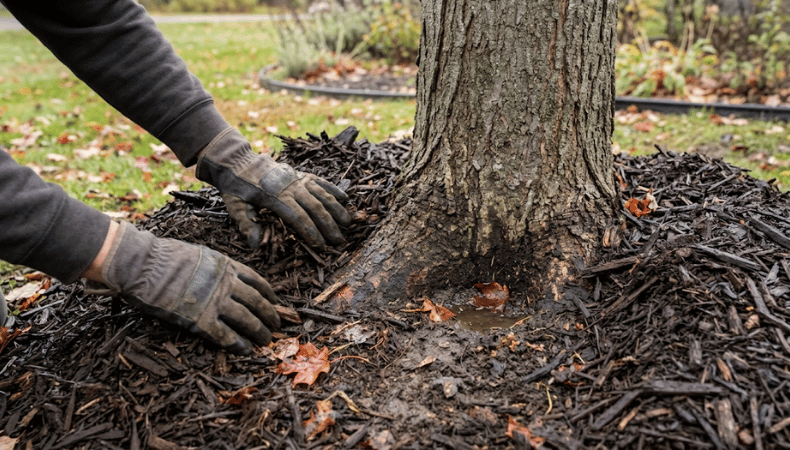
The root zone is the hardest area to see, which makes it the part of a walk-through homeowners most often miss.
A Great Way to Get Ahead of Winter Is a Limbwalker Fall Tree Assessment
If leaf-drop has revealed a co-dominant stem, included bark, or anything else you’re not quite sure about, request an estimate online and get the eyes of one of Limbwalker’s ISA Certified Arborists before winter fully sets in.
Vermont, Let’s Grow Great Trees Together
Whether you need pruning, planting, removal, pest and disease management, or help navigating a shoreline protection permit, we’re here and ready to bring our experience to your property.
Our Articles!
Can You Remove Trees Near a Shoreline in Vermont?
Removing a tree near a Vermont shoreline? Different rules apply within 100 and 250 feet of the water. Learn what homeowners need to know before cutting.
Why Fall Is a Great Time to Plant Trees in Vermont
Planting trees in Vermont this fall? Cooler weather and warm soil can help new trees establish strong roots before winter. Learn how to get started.
Why Are My Tree’s Leaves Turning Yellow in Summer?
Seeing yellow leaves or early drop on your Vermont trees this summer? Learn what heat and drought stress look like and when to call a certified arborist.
