
Blog Topics
During this summer’s Extreme Heat Warning, Burlington officials urged residents to prepare for dangerously hot conditions as heat index values climbed as high as 106°F across the Champlain Valley. While people can cool off indoors, trees have to withstand days of intense heat and dry soil.
If your tree’s leaves have started turning yellow, it’s often one of the first signs that prolonged heat and drought are beginning to take a toll. Understanding why this happens and what to do next can help you protect your tree before the stress becomes more severe.
Key Takeaways
- Summer stress symptoms often trace back to spring or early-summer conditions, not a sudden new problem.
- Yellowing, marginal leaf scorch, wilting, and early leaf drop are the most common signs of heat and drought stress.
- Deep, infrequent watering and proper mulching help many stressed trees recover — but not all.
- More than 50% leaf loss, major dieback, or one-sided canopy decline is a signal to have an ISA Certified Arborist take a look at your tree.
Why Do Trees Show Stress Symptoms in the Middle of Summer?
Heat and drought stress is cumulative. Trees don’t usually show symptoms after a few hot days. Instead, weeks of high temperatures and dry soil gradually reduce the amount of water their roots can supply to the canopy. By the time leaves begin turning yellow, browning around the edges, or dropping early, the tree may have been struggling for quite some time.
In Vermont, seasonal weather patterns can make that stress even worse. A wet spring encourages trees to produce abundant new growth, but if June and July become hot and dry, that larger canopy requires more water than the roots can provide. The result is a tree that appeared healthy earlier in the season but begins showing visible signs of stress as summer wears on.
What Causes Summer Tree Stress in the Champlain Valley?
In the Champlain Valley, summer tree stress is caused by a handful of things, and most are tied to water and the soil around the roots:
- Drought and Uneven Rainfall : Without steady moisture, roots can’t move nutrients and photosynthesis slows (primary cause)
- Heat and High Evaporation Demand : Hot days pull water from leaves faster than roots can replace it and hit exposed south- and west-facing trees the hardest
- Compacted or Disturbed Soil : Where packed soil limits the water and oxygen reaching roots (common on graded landscapes and new construction in Bristol and Vergennes)
- Root Competition from Turf : Grass growing under the canopy competes for the same water during dry spells
- Past Root Damage : Digging or construction can injure roots in ways that lag months or even years, usually surfacing as one-sided decline
You can see this often on Ferrisburgh’s lakeside and agricultural properties and the larger rural lots throughout Addison County, where big established hardwoods make individual trees both more visible and consequential. Newly planted and young trees are the most vulnerable because of their limited root systems that can’t buffer a dry spell.
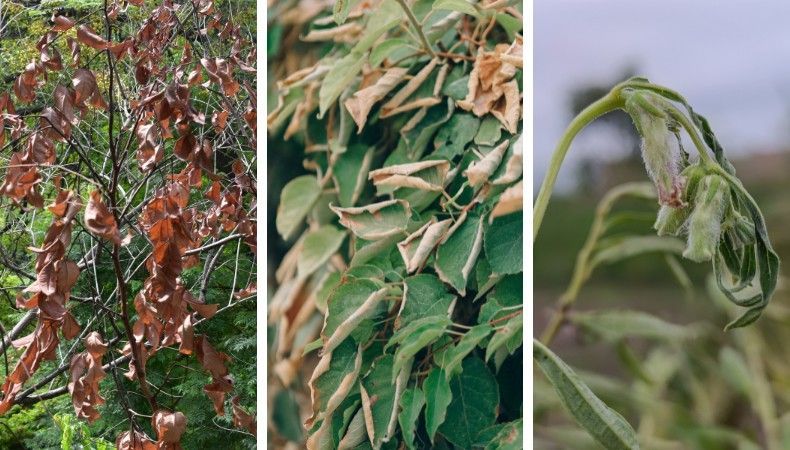
Browning along the leaf margins and midday wilting are two of the clearest signs of heat and drought stress.
What Does Summer Tree Stress Look Like?
Usually, summer tree stress shows up as some mix of yellow, scorched leaf edges, wilting, and early leaf drop. Knowing what each looks like can help you gauge the necessary level of worry.
Yellow and Browning Leaves
Yellow or browning leaves are the most common sign, and the pattern generally gives them away:
- Starts on the most sun-exposed areas (the top of the crown and the branch tips)
- Looks fairly uniform across exposed areas rather than spotty
- Appears off-season, unlike the predictable fall color shift
Marginal Leaf Scorch
Marginal leaf scorch is one of the most recognizable signs of heat and drought stress. It develops when leaves lose water faster than the roots can replace it, causing the outer edges to dry out first. Look for:
- Browning along the leaf edges while the center stays greener
- Worst on the south- and west-facing sides, where afternoon sun and heat hit hardest
Wilting and Leaf Curl
Wilting and leaf curl are how a tree conserves moisture. You’ll notice:
- Daytime wilting that recovers overnight (not alarming on its own)
- Wilting that persists into the morning, which is more serious
- Leaves rolling or curling to cut down sun exposure
Early Leaf Drop and One-Sided Dieback
Early leaf drop and one-sided dieback range from normal to concerning:
- A healthy tree may shed up to about 10% of its leaves in a heat wave (a survival tactic, not a death sentence)
- The oldest, most exposed leaves drop first
- Dieback on one side or section usually points to root-zone damage there, not uniform drought
Heat and drought stress often causes widespread yellowing, browning, or leaf drop across the tree, especially on the sunniest sides. If the symptoms are limited to one branch or are accompanied by spots, holes, sticky residue, or webbing, a pest or disease may be contributing to the problem. Our guide to tree pests and diseases in Vermont explains what to look for.
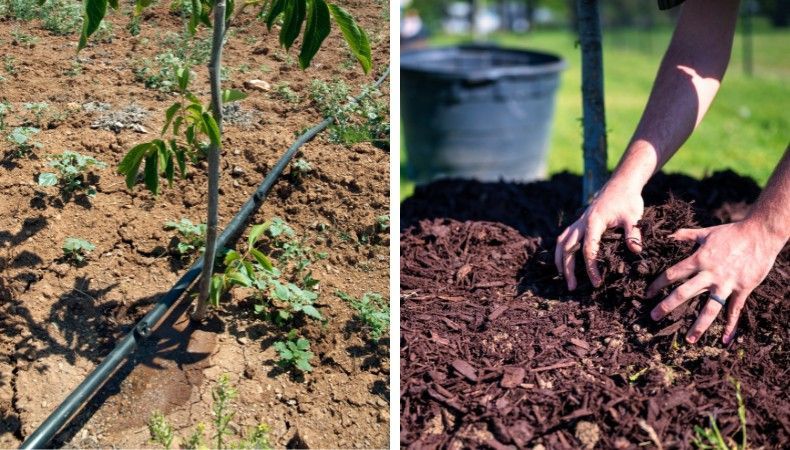
Deep, infrequent watering out toward the drip line, paired with a proper mulch ring, helps many stressed trees recover.
Can You Help a Stressed Tree Recover?
In many cases, yes. Trees experiencing heat and drought stress can often recover if the underlying problem is addressed before significant damage occurs. While recovery isn’t guaranteed, providing the right care can improve your tree’s chances of bouncing back.
What to Do:
- Water deeply, slowly, and infrequently out toward the drip line rather than at the trunk, aiming for soil that’s moist but not soggy. Early morning is best, and a soaker hose makes it easy.
- Apply a 2–4 inch layer of organic mulch out toward the drip line to hold moisture and moderate soil temperature—but keep it off the trunk and root flare (no “mulch volcano”).
What Not to Do:
- Fertilize during heat or drought. It forces growth the tree can’t support and makes the stress worse.
- Prune live branches off a tree that’s already stressed. Removing healthy foliage cuts into the photosynthesis it needs to bounce back and adds wounds it now has to seal, adding even more stress. (Hazardous deadwood is a separate, professional call.)
Root damage itself can’t be reversed, but its effects can usually be managed. For a closer look, a tree health assessment from an ISA Certified Arborist can highlight the actual needs of a stressed tree.
When Does Summer Stress Become a Hazard?
Summer stress becomes a hazard when a drought-weakened tree develops crown dieback or compromised root anchorage, which turns a health issue into a failure candidate going into fall storm season. Rarely does a weakened tree fall when you first notice it on a calm summer day; it falls later, when autumn’s winds and saturated soils show up.
These signs warrant a professional assessment, and also overlap with the broader warning signs of hazardous trees:
- More than 50% leaf loss across the canopy
- Significant branch dieback
- Cracks in the bark or trunk
- One-sided or sectional canopy decline, which can signal a root-anchorage problem
An ISA Certified Arborist will evaluate the entire site to identify what’s causing the stress, including issues like soil compaction or root damage that aren’t visible from the surface. That allows them to recommend the most appropriate treatment, whether it’s improving growing conditions, monitoring the tree, or, in severe cases, recommending removal.
Frequently Asked Questions About Leaves Turning Yellow in Summer
Is heat and drought stress the only thing that causes yellow leaves in summer?
No. While prolonged heat and dry weather are among the most common reasons trees develop yellow leaves in summer, other problems can produce similar symptoms. Nutrient deficiencies, compacted soil, root damage, overwatering, pests, and diseases can all interfere with a tree’s ability to produce healthy green leaves. The timing of the yellowing and any additional symptoms help determine the underlying cause.
Can overwatering turn my tree’s leaves yellow?
Yes. Waterlogged soil starves roots of oxygen, and the leaves react much the way they do to drought—yellowing and dropping. If the ground around your tree stays soggy for days at a time, easing off the water will help more than adding to it.
How long will it take to know whether my tree recovered?
Expect to wait through the rest of the season, and often into the next. The clearest signal is the following spring’s leaf-out: full and vigorous means it pulled through, thin and sparse means it’s still struggling. In the meantime, the absence of new dieback is an encouraging sign that the tree is stabilizing.
Can one stressful summer cause lasting damage?
A single hard summer rarely kills an established tree outright, but it can leave a mark — reduced growth, some dieback, or a weak point that surfaces in a later storm. That’s why catching stress early matters more than the one hot season on its own.
Can yellow leaves turn green again once conditions improve?
Generally, a leaf that’s already yellow won’t turn green again, but that isn’t necessarily a measure of success. A tree caught early can push a fresh flush of healthy growth once conditions improve, although sometimes not until the next spring. Recovery is about the tree bouncing back, not the leaves you’ve already lost.

When more than half the canopy is affected or one side is declining, an ISA Certified Arborist can pinpoint what a tree actually needs.
Combat Summer Stress with Limbwalker Tree Service
The yellowing leaves you’re seeing now are often the result of weeks of accumulated heat and drought stress, but early action can still make a meaningful difference in your tree’s recovery. If a tree on your Vergennes property is showing more than a passing case of summer stress, it’s worth a professional set of eyes.
Request an estimate or call Limbwalker Tree Service today at 802-231-0129, and we’ll come see what’s going on under the canopy. Great trees don’t happen by accident, they happen with Limbwalker.
Vermont, Let’s Grow Great Trees Together
Whether you need pruning, planting, removal, pest and disease management, or help navigating a shoreline protection permit, we’re here and ready to bring our experience to your property.
Our Articles!
What Does an Arborist Look For During a Fall Tree Assessment in Vermont?
Wondering what a Vermont arborist checks during a tree assessment? See the canopy, trunk, and root signs that signal it's time to call one before winter.
Can You Remove Trees Near a Shoreline in Vermont?
Removing a tree near a Vermont shoreline? Different rules apply within 100 and 250 feet of the water. Learn what homeowners need to know before cutting.
Why Fall Is a Great Time to Plant Trees in Vermont
Planting trees in Vermont this fall? Cooler weather and warm soil can help new trees establish strong roots before winter. Learn how to get started.
