
Blog Topics
Trees provide significant benefits to our homes and cities, but when trees fall and injure people or damage property, they are liabilities. Taking care of tree hazards makes your property safer and prolongs the life of the tree.
Trees are an important part of our world. They offer a wide range of benefits to the environment and provide tremendous beauty.
However, trees may be dangerous. Trees or parts of trees may fall and cause injury to people or damage to property. We call trees in such situations hazardous, to signify the risk involved with their presence. While every tree has the potential to fall, only a small number actually hit something or someone.
It is an owner’s responsibility to provide for the safety of trees on his or her property. This brochure provides some tips for identifying the common defects associated with tree hazards. However, evaluating the seriousness of these defects is best done by a professional arborist. Regular tree care will help identify hazardous trees and the risk they present. Once the hazard is recognized, steps may be taken to reduce the likelihood of the tree falling and injuring someone.
Hazardous Trees and Utility Lines
Trees that fall into utility lines have additional serious consequences. Not only can they injure people or property near the line, but hitting a line may cause power outages, surges, fires, and other damage. Downed lines still conducting electricity are especially dangerous. A tree with a potential to fall into a utility line is a very serious situation.
Tree Hazard Checklist
Consider these questions:
- Are there large dead branches in the tree?
- Are there detached branches hanging in the tree?
- Does the tree have cavities or rotten wood along the trunk or in major branches?
- Are mushrooms present at the base of the tree?
- Are there cracks or splits in the trunk or where branches are attached?
- Have any branches fallen from the tree?
- Have adjacent trees fallen over or died?
- Has the trunk developed a strong lean?
- Do many of the major branches arise from one point on the trunk?
- Have the roots been broken off, injured, or damaged by lowering the soil level, installing pavement, repairing sidewalks, or digging trenches?
- Has the site recently been changed by construction, raising the soil level, or installing lawns?
- Have the leaves prematurely developed an unusual color or size?
- Have trees in adjacent wooded areas been removed?
- Has the tree been topped or otherwise heavily pruned?
Defects in Urban Trees
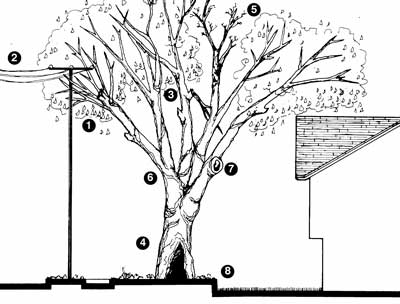 The following are defects or signs of possible defects in urban trees (see figure):
1. regrowth from topping, line clearance, or other pruning
2. electrical line adjacent to tree
3. broken or partially attached branch
4. open cavity in trunk or branch
5. dead or dying branches
6. branches arising from a single point on the trunk
7. decay and rot present in old wounds
8. recent change in grade or soil level, or other construction
Defects in Rural Trees
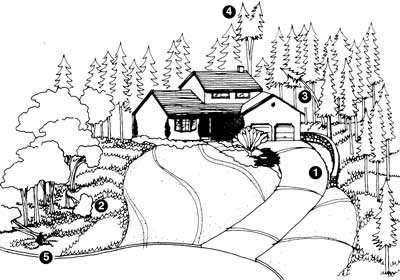
The following are defects or signs of possible defects in rural trees (see figure):
1. recent site construction, grading and tree removal, clearing of forests for development
2. previous tree failures in the local area
3. tree leaning near a target
4. forked trunk; branches and stems equal in size
5. wet areas with shallow soil
Managing Tree Hazards
An arborist can help you manage the trees on your property and can provide treatments that may help make your tree safer, reducing the risk associated with hazardous trees. An arborist familiar with hazard tree evaluation may suggest one or more of the following:
- Remove the target. While a home or a nearby power line cannot be moved, it is possible to move picnic tables, cars, landscape features, or other possible targets to prevent them from being hit by a falling tree.
- Prune the tree. Remove the defective branches of the tree. Because inappropriate pruning may weaken a tree, pruning work is best done by an ISA Certified Arborist.
- Cable and brace the tree. Provide physical support for weak branches and stems to increase their strength and stability.
- Provide routine care. Mature trees need routine care in the form of water, fertilizer (in some cases), mulch, and pruning as dictated by the season and their structure.
- Remove the tree. Some hazardous trees are best removed. If possible, plant a new tree in an appropriate place as a replacement.
Recognizing and reducing tree hazards not only increases the safety of your property and that of your neighbors but also improve the tree’s health and may increase its longevity!
Ensuring Quality Care for Your Tree
Trees are assets to your home and community and deserve the best possible care. If you answered “yes” to any of the questions in the tree hazard checklist or see any of the defects contained in the illustrations, your tree should be examined by an ISA Certified Arborist.
For a list of ISA Certified Arborists in your area, please visit www.treesaregood.com. If your tree is located near a power line, contact your local electrical utility.
Developed by the International Society of Arboriculture (ISA), a non-profit organization supporting tree care research around the world and is dedicated to the care and preservation of shade and ornamental trees. For further information, contact:
ISA, P.O. Box 3129, Champaign, IL 61826-3129, USA.
E-mail inquires: isa@isa-arbor.com
© 2007 International Society of Arboriculture.
Vermont, Let’s Grow Great Trees Together
Whether you need pruning, planting, removal, pest and disease management, or help navigating a shoreline protection permit, we’re here and ready to bring our experience to your property.
Our Articles!
What Tree Pests and Diseases You Should Watch for in Vermont
A guide to tree pests and diseases in Vermont that homeowners should watch for and what to do next if you suspect your tree is at risk of decline.
How to Identify Hazardous Trees in Vermont
Worried about a tree on your property? Learn the warning signs of hazardous trees in Vermont and when professional evaluation or removal may be needed.
Best Flowering Trees to Plant in the Champlain Valley
A helpful guide to discover the best flowering trees in Vermont, including the best species for the Champlain Valley, when to plant, and first-year care tips.
