
Blog Topics
The climate in Vermont is changing. In fact, in 2023, the USDA’s Plant Hardiness Zone Map was updated and moved a majority of the Champlain Valley—including Middlebury, Vergennes, and Bristol—into zones 5a and 5b, which allows some flowering tree species that previously struggled in our climate to grow more reliably.
But that doesn’t mean Vermont has suddenly become an easy climate for all ornamental trees. Spring frosts, temperature swings, saturated soils, and long winters still play a major role in how well a tree establishes and blooms year after year. That combination of slightly milder growing conditions alongside unpredictable weather is exactly why choosing the right flowering tree still matters for your landscape.
Key Takeaways
- Not every flowering tree performs well in Vermont’s freeze-thaw cycles, heavy soils, and unpredictable springs, so species selection matters.
- Native flowering trees, like serviceberry, pagoda dogwood, and American linden, are the most reliable long-term performers in Champlain Valley landscapes.
- Spring (mid-April through early June) and fall (September through mid-October) are both ideal planting windows, with fall usually being easier on the roots.
- Insufficient watering is the leading cause of death for newly planted trees, and first-season care matters more than other factors.
What Makes a Flowering Tree a Good Fit for Vermont?
A flowering tree fits Vermont’s climate when it combines cold hardiness, tolerance for frosts in late spring, and the ability to handle the clay-heavy soils common throughout the Champlain Valley. Addison County’s recent USDA zone update to zone 5a-5b, with a few pockets near the lakeshore edging close to zone 6a, highlights a significantly warmer climate than the previous 4b designation many people initially planned around.
Species selection is much more important here than in milder regions. A tree rated at the edge of its hardiness range can survive anywhere from five to ten years and then fail in a single hard spring. This can be routine with zone-5 ornamentals that were planted without thinking of siting.
The Champlain Valley Microclimate Advantage
Lake Champlain is a thermal buffer, moderating both summer highs and winter lows across the lowland towns of Addison County. Middlebury, Vergennes, and Bristol all sit within this moderating zone, which is why zone-5 ornamentals that struggle in Rutland or Newport tend to perform well here.
Sheltered sites within these towns, such as south-facing yards with wind protection, can support species that wouldn’t survive elsewhere in Vermont. For specifics about your own address, the USDA Plant Hardiness Zone Map is a resource of good authority.
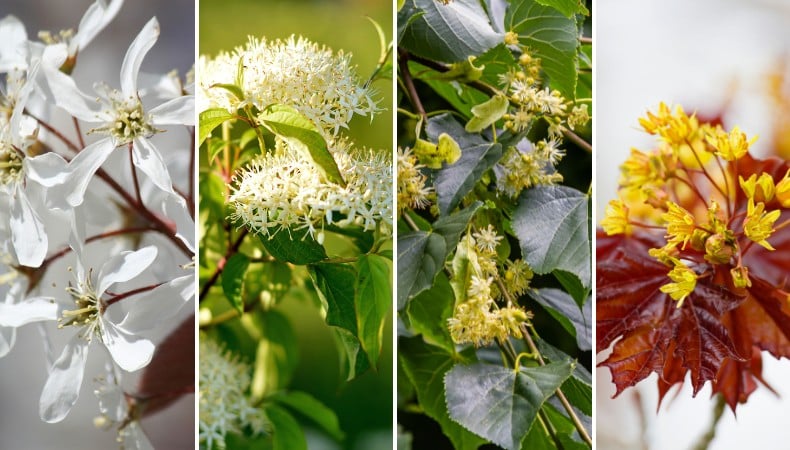
Vermont’s most reliable native flowering trees (from left): serviceberry, pagoda dogwood, American linden, and red maple.
Which Flowering Trees Grow Best in Vermont?
In Vermont, the flowering trees that perform most reliably are natives adapted to the region’s cold, short seasons, with a handful of proven non-native ornamentals rounding out the options. Native species tend to establish faster, support more wildlife, and cope better with late frost than their imported counterparts.
Native Flowering Trees (Best Long-Term Performers)
- Serviceberry (Amelanchier): Small tree or large shrub with white flowers in late April, edible purple berries in June, and strong fall color. Tolerates partial shade and appears on Audubon Vermont’s superstar plant list .
- Pagoda Dogwood (Cornus alternifolia): Tops out near 20 feet with distinctive tiered, horizontal branching, white spring blooms, and black berries that attract songbirds.
- American Linden/Basswood (Tilia americana): Larger shade tree with fragrant pale-yellow flowers in June; one of the most important pollinator trees native to the region.
- Red Maple (Acer rubrum): Not usually thought of as ornamental, but the early red flower clusters are genuinely striking against a still-bare landscape, and the tree is as reliable as they come.
Non-Native Ornamentals Worth Considering
- Eastern Redbud (Cercis canadensis): Magenta blooms in early May. Historically zone-marginal in Vermont but more viable in the Champlain Valley under the updated hardiness zones.
- Japanese Tree Lilac (Syringa reticulata): Cold-hardy to zone 3, white panicle blooms in June, and a classic, trouble-free choice for Vermont yards.
- Star Magnolia (Magnolia stellata): Hardier than saucer magnolia and workable in sheltered Middlebury or Vergennes sites; still benefits from wind protection and siting that delays bud break to avoid damage from late frosts.
- Flowering Crabapple (Malus): Reliable in Vermont when you choose disease-resistant cultivars; avoid older varieties that are prone to apple scab and fire blight.
TREES TO AVOID: Some ornamental trees still struggle with Vermont’s freeze-thaw cycles and late spring frosts. Flowering dogwood (Cornus florida) and many saucer magnolias remain inconsistent performers in the Champlain Valley, while black cherry can create messy fruit drop near patios and driveways.
If you need help selecting and installing the right species for your site, our team provides professional tree planting across Addison County.
When Is the Best Time to Plant Flowering Trees in the Champlain Valley?
The best times to plant flowering trees in Vermont are spring (mid-April through early June) and fall (September through mid-October); both windows let a tree establish before the arrival of extreme temperatures. Spring planting gives you an entire growing season of root development before winter, and nursery selection is usually at its peak. Fall planting puts the tree into cooler, moister soil that’s gentler on stressed roots.
The tree then goes dormant in place and wakes up the next spring partially established already. On average, the last frost in Burlington is May 6, so planting after it gives your trees the lowest risk of a cold setback on new foliage.
Prior to planting, check the following:
- Sun exposure through the day (most flowering trees want at least six hours)
- Drainage in the planting area (avoid spots where water sits after rain)
- Overhead or underground utility clearance.
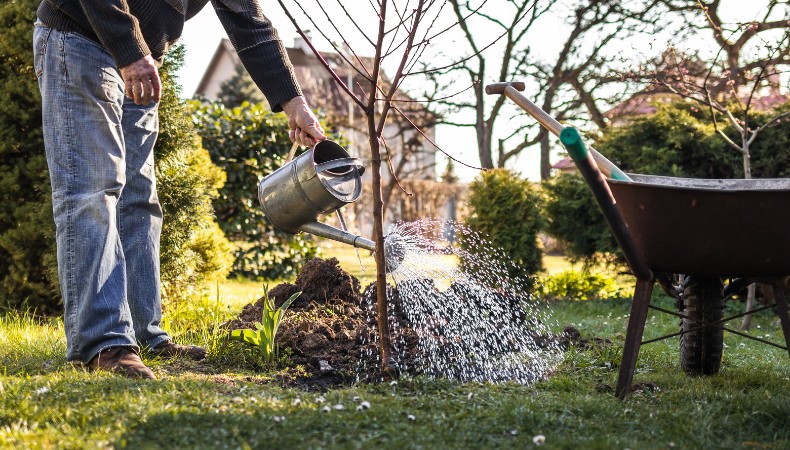
Deep, consistent watering during the first growing season is the single biggest factor in a flowering tree’s long-term survival.
How Do You Care for a Newly Planted Flowering Tree?
The first growing season has more impact on a flowering tree’s long-term health than almost anything else. Most newly planted trees don’t fail because they were poor species choices—they fail because the roots never fully establish. In Vermont, that usually comes down to inconsistent watering, improper mulching, or too much early pruning.
Consistent Watering Supports Root Establishment
Consistent watering is the single biggest factor in first-year survival. Newly planted flowering trees should receive roughly 1 to 1.5 gallons of water per inch of trunk diameter per watering. During the first week or two after planting, watering may need to happen daily depending on rainfall and soil conditions. After that, transition to a slower, deep soak once per week through the rest of the growing season.
Even after the first year, supplemental watering is often necessary during drought periods until the tree is fully established, which usually takes two to three years. Wilting, curling, or scorched leaves during summer heat are usually signs the root zone needs a deeper soak.
Proper Mulching Protects the Root Zone
Mulch helps regulate soil temperature, retain moisture, and reduce competition from grass around the root zone. Apply a two- to four-inch layer of wood chip mulch in a wide ring around the tree, but keep it pulled several inches away from the trunk itself.
Piling mulch directly against the bark—often called a “mulch volcano”—traps moisture against the trunk and can eventually lead to decay, insect issues, and gradual decline. If the planting site
is especially windy or the rootball feels unstable, staking may help temporarily, but stakes should usually be removed after the first growing season.
Early Pruning Helps Guide Long-Term Growth
Newly planted flowering trees should still be inspected and pruned as needed during their early years, but the focus should be on structure rather than aggressive size reduction. Remove broken, damaged, or poorly attached branches early while encouraging a strong central structure that will support the tree as it matures.
Light structural pruning performed consistently over time helps reduce future problems with weak branch unions, crossing limbs, and storm damage. Heavy pruning immediately after planting, however, can place additional stress on a tree that is still trying to establish roots.
When to Call a Professional Arborist
Most flowering tree decisions appear simple at first and then quickly get increasingly complicated, which is why a consultation with a Certified Arborist pays off before the first shovel even touches the ground. A few of the situations where professional input can be a vital difference-maker include:
- Matching Species to Site Conditions: Drainage, soil type, sun exposure, and proximity to structures or utility lines all shape what will thrive where. This is the highest-impact decision in any planting project.
- Sourcing Quality Nursery Stock: Big-box trees generally carry unverified hardiness labels, poor root systems, or pest issues. An arborist can point you to reputable regional nurseries.
- Diagnosing a Struggling Young Tree: If a recently planted tree isn’t thriving in its first season, early intervention is usually the difference between recovery and replacement.
Frequently Asked Questions About Flowering Trees
What flowering trees are native to Vermont?
Serviceberry, pagoda dogwood, American linden (basswood), red maple, and black cherry are all native to Vermont. For residential landscapes, serviceberry and pagoda dogwood are the strongest ornamental picks because they stay a manageable size and offer multi-season interest.
What is the best flowering tree for a small yard in Vermont?
Serviceberry, pagoda dogwood, and Japanese tree lilac all top out around 20 to 30 feet, which makes them well-suited for smaller lots. They provide spring flowers, summer foliage, and fall interest without overwhelming a residential landscape.
When do flowering trees bloom in Vermont?
In Vermont, most flowering trees bloom between late April and early June. Serviceberry is typically the earliest in the Champlain Valley, followed by crabapple and redbud in May, with Japanese tree lilac and American linden rounding out the season in late May and June.
Can magnolias grow in Vermont?
Star magnolia (Magnolia stellata) can successfully grow in sheltered Champlain Valley sites, such as parts of Middlebury and Vergennes. Saucer magnolia is more sensitive to late spring frosts, and flower buds are often damaged in cold years, which is why we don’t usually recommend it.
How long does it take a flowering tree to bloom after planting?
Most flowering trees start blooming within two to four years of planting, depending on species, nursery stock size, and growing conditions. Trees that receive consistent first-season watering and are matched well to their site bloom earlier and more reliably than those that struggle to establish.
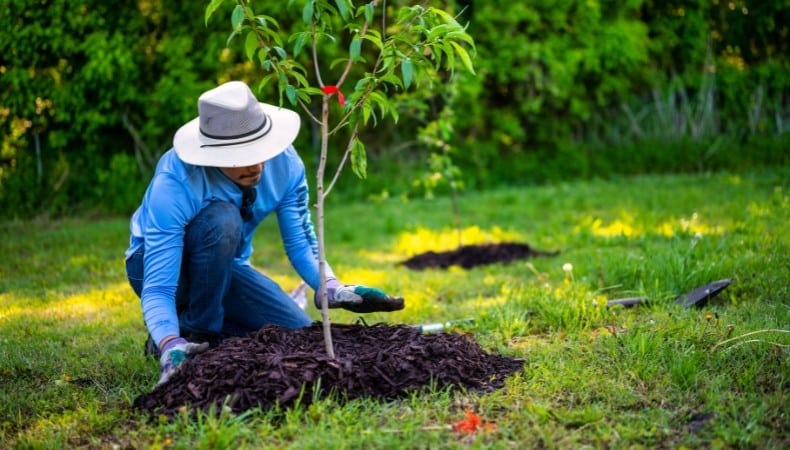
A proper mulch ring (kept several inches away from the trunk) protects the root zone without creating a damaging “mulch volcano.”
Plant for the Long Term with Limbwalker Tree Service
The two common misconceptions about flowering trees regard species selection and planting timing. Both are fixable before a shovel gets some dirt, though. Still, it’s important to match the tree to your specific site, plant within the windows that are best for the Champlain Valley, and water it like you mean it through the first summer.
Great trees don’t happen by accident. If you want help choosing the right species for your property in Middlebury, Vergennes, Bristol, or anywhere else in the Champlain Valley, schedule a planting consultation with our Certified Arborists. We’ll walk the site with you, talk through options, and help you plant something that will be blooming for decades.
Vermont, Let’s Grow Great Trees Together
Whether you need pruning, planting, removal, pest and disease management, or help navigating a shoreline protection permit, we’re here and ready to bring our experience to your property.
Our Articles!
What Does an Arborist Look For During a Fall Tree Assessment in Vermont?
Wondering what a Vermont arborist checks during a tree assessment? See the canopy, trunk, and root signs that signal it's time to call one before winter.
Can You Remove Trees Near a Shoreline in Vermont?
Removing a tree near a Vermont shoreline? Different rules apply within 100 and 250 feet of the water. Learn what homeowners need to know before cutting.
Why Fall Is a Great Time to Plant Trees in Vermont
Planting trees in Vermont this fall? Cooler weather and warm soil can help new trees establish strong roots before winter. Learn how to get started.
