
Blog Topics
This brochure is a home owner’s guide to planning for, evaluating, and reducing possible financial losses on trees, specimen shrubs, and evergreens.
What Are Your Trees Worth?
Almost everyone knows that trees and other living plants are valuable. They beautify our surroundings, purify our air, act as sound barriers, manufacture precious oxygen, and help us save energy through their cooling shade in summer and their wind reduction in winter.
Many people don’t realize, however, that plants have a dollar value of their own that can be measured by competent plant appraisers.
If your trees or shrubs are damaged or destroyed, you may be able to recapture your loss through an insurance claim or as a deduction from your federal income tax.
Some Practical Advice
Here is some practical advice that may help you find out what your trees and plants are worth (a process known as valuation).
Planning for Highest Value
A professional in the tree, nursery, or landscape industry can help you plan, develop, install, and care for all of your trees and plants so that each of them will be worth more to you.
How Your Trees and Shrubs Are Valuated
Seek the advice of professionals in this industry who have developed a set of guidelines for the valuation. Such guidelines have been widely adopted in the field and are recognized by insurance companies, the courts, and, in some cases, the Internal Revenue Service (IRS).
What to Do If You Suffer Loss or Damage to Your Landscape Plants
A casualty loss is defined by the IRS as “… a loss resulting from an identifiable event of sudden, unexpected, or unusual nature. This definition can include such events as vehicular accidents, storms, floods, lightning, vandalism, or even air and soil pollution.
If you suffer damage to trees or landscaping from any type of casualty, first consult your home owner’s insurance policy to determine the amount and kind of coverage. Contact the insurance company to have an appraisal made by a competent tree and landscape professional who is experienced in plant appraisal. Have the appraisal made right after your loss or damage.
The tree and landscape appraiser accomplishes many things for you. The professional can see things you might miss, help correct damage, and prescribe remedies you may be able to do yourself. The appraiser will establish the amount of your loss in financial terms, including the cost of removing debris and making repairs as well as replacements. All of these steps are wise investments and well worth the cost you may incur for the inspection.
Four Factors in Professional Valuation of Trees and Other Plants
Size. Sometimes the size and age of a tree are such that it cannot be replaced. Trees that are too large to be replaced should be assessed by professionals who use a specialized appraisal formula.
Species or classification. Trees that are hardy, durable, highly adaptable, and free from objectionable characteristics are most valuable. They require less maintenance; they have sturdy, well-shaped branches, and pleasing foliage. Tree values vary according to your region, the “hardiness zone, and even state and local conditions. If you are not familiar with these variables, be sure your advice comes from a competent source.
Condition. The professional will also consider the condition of the plant. Obviously, a healthy, well-maintained plant has a higher value. Roots, trunk, branches, and buds need to be inspected
Location. Functional considerations are important. A tree in your yard may be worth more than one growing in the woods. A tree standing alone often has a higher value than one in a group. A tree near your house or one that is a focal point in your landscape tends to have more value. The site, placement, and contribution of a tree to the overall landscape help determine the overall value of the plant attributable to location.
All of these factors can be measured in dollars and cents. They can determine the value of a tree, specimen shrubs, or evergreens, whether for insurance purposes, court testimony in lawsuits, or tax deductions.
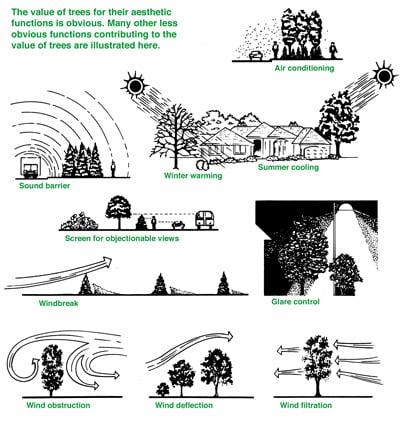
Checklist
These steps should be taken before and after any casualty loss to your trees and landscape. Taking them can improve the value of your investment in nature’s green, growing gifts and prevent financial loss should they be damaged or destroyed.
- Plan your landscaping for both beauty and functional value.
- Protect and preserve to maintain value.
- Take pictures of trees and other landscape plants now while they are healthy and vigorous. Pictures make “before and after comparisons easier and expedite the processing of insurance claims or deductions for losses on federal tax forms.
- Check your insurance. In most cases, the amount of an allowable claim for any one tree or shrub is a maximum of $500.
- For insurance, legal, and income tax purposes, keep accurate records of your landscape and real estate appraisals on any losses.
- Consult your local Plant Health Care professional at every stage in the life cycle of your landscape (planning, planting, care) and to make sure you do not suffer needless financial loss when a casualty strikes.
Developed by the International Society of Arboriculture (ISA), a non-profit organization supporting tree care research around the world and is dedicated to the care and preservation of shade and ornamental trees. For further information, contact:
ISA, P.O. Box 3129, Champaign, IL 61826-3129, USA.
E-mail inquires: is*@*******or.com
© 2007 International Society of Arboriculture.
Vermont, Let’s Grow Great Trees Together
Whether you need pruning, planting, removal, pest and disease management, or help navigating a shoreline protection permit, we’re here and ready to bring our experience to your property.
Our Articles!
Can You Remove Trees Near a Shoreline in Vermont?
Removing a tree near a Vermont shoreline? Different rules apply within 100 and 250 feet of the water. Learn what homeowners need to know before cutting.
Why Fall Is a Great Time to Plant Trees in Vermont
Planting trees in Vermont this fall? Cooler weather and warm soil can help new trees establish strong roots before winter. Learn how to get started.
Why Are My Tree’s Leaves Turning Yellow in Summer?
Seeing yellow leaves or early drop on your Vermont trees this summer? Learn what heat and drought stress look like and when to call a certified arborist.
